
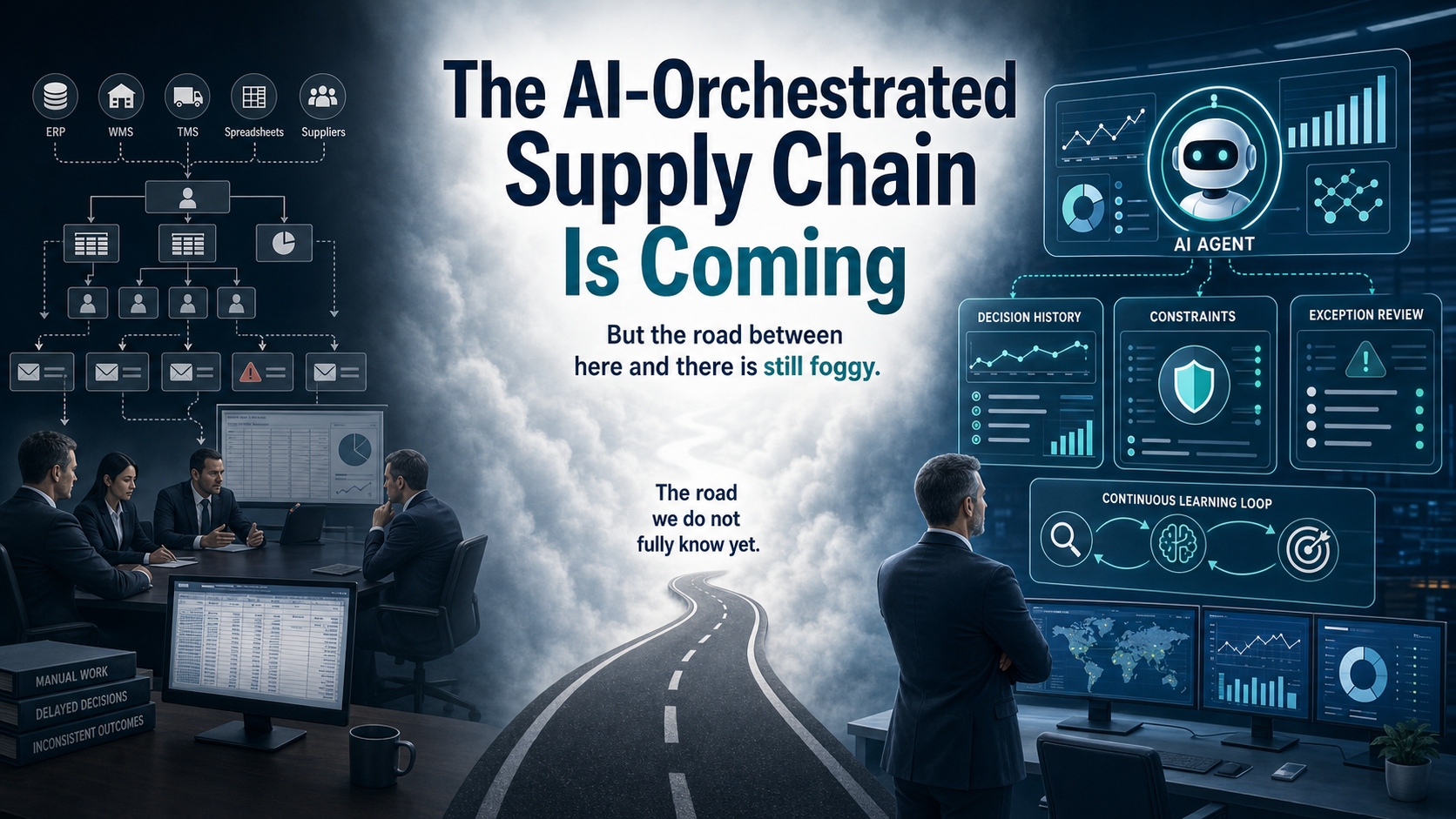
That picture is attractive. It is also incomplete.
The distance between today's operating model and that future model is still unclear. Many companies know the direction, but they do not yet know the road. Pretending that the road is fully clear may be one of the fastest ways to waste the next AI budget.
The real question is not only where AI can make Supply Chain faster. The more important question is whether we would design the same process if AI was already at the center.
In many cases, the honest answer is no.
The Traditional Model Still Depends On Hidden Human Intelligence
Most Supply Chain organizations still operate through a traditional model. Systems hold data. People interpret it. Meetings align the organization. Escalations move decisions forward. Excel fills the gaps. Knowledge lives in the heads of experienced planners, managers and functional experts.
This model works because people make it work. That is also its weakness.
Every handover removes context. Every meeting compresses reality into a slide. Every escalation depends on who is in the room. Every planner carries knowledge the system cannot see. The process may look structured from the outside, but a large part of its intelligence is still informal, manual and difficult to reuse.
That is why simply adding AI on top of this model is not enough. It may create faster summaries, faster reporting and faster analysis. Useful, yes. Transformational, not necessarily.
If the underlying decision logic remains hidden, AI becomes another layer on top of an unclear process.
The Future Model Is Not A Tool. It Is An Operating Model.
The future Supply Chain model looks different because AI does not sit on top of the old process as a reporting assistant. It becomes part of how the process senses, recommends, explains and learns.
In that model, AI agents support repeated decisions. Humans own judgment, exceptions and accountability. Decision history is visible. Constraints are explicit. Operational knowledge is formalized and reused. The system can explain not only what happened, but why a decision was made.
That is not a productivity upgrade. It is a structural change.
Many companies still treat AI as a co-pilot added to the current workflow. That may be a useful first step, but it is not the destination. If AI can read the artifacts of work, connect signals, understand decisions and support action, then the operating model itself becomes the question.
The process becomes less about moving information up and down a hierarchy. It becomes more about making the organization legible enough for humans and AI to act on the same reality.
This is where the conversation becomes more difficult, because the target is no longer "implement an AI tool." The target is to redesign how decisions flow through the business.
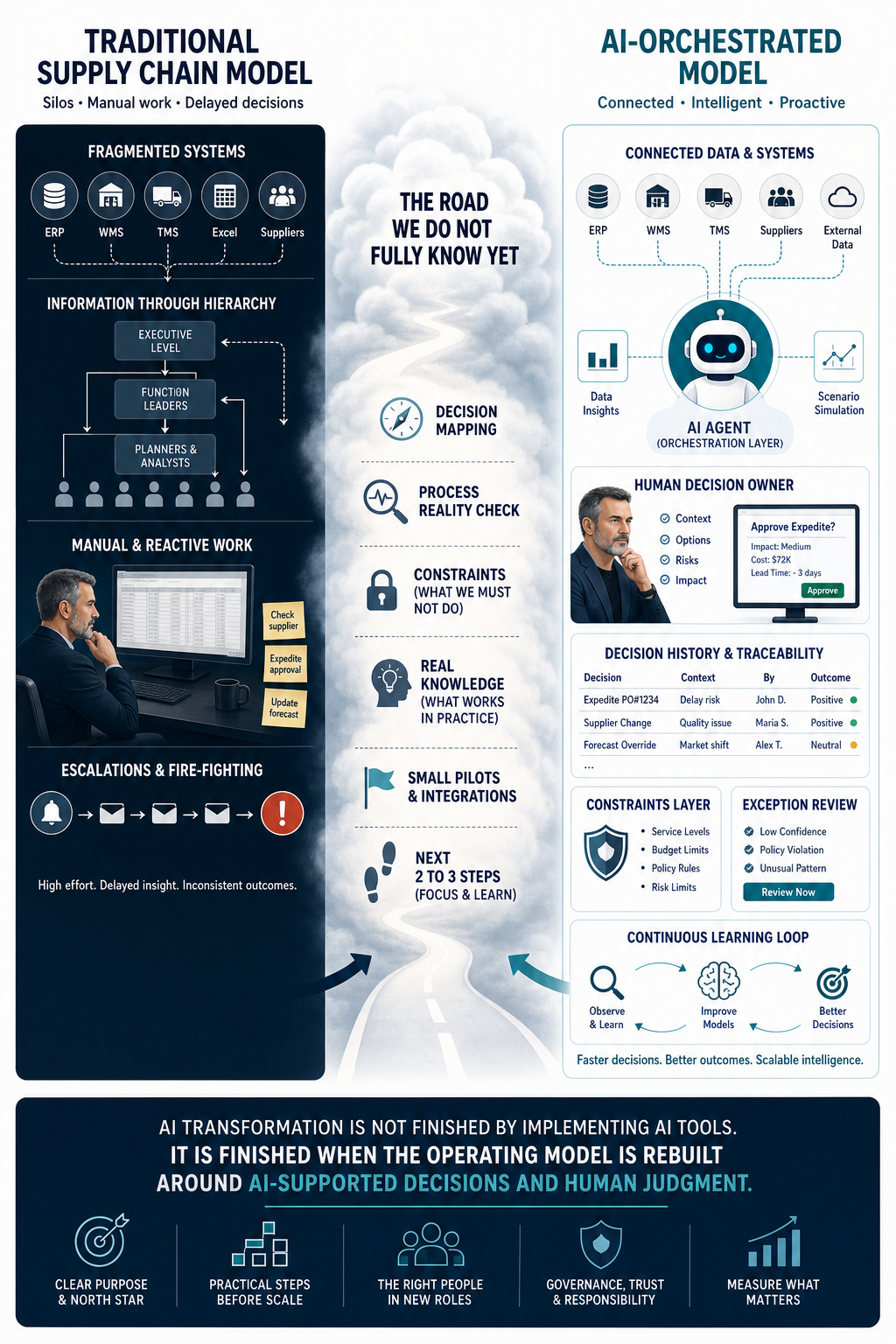
The Cloud In The Middle Is The Real Work
Between the traditional model and the AI-orchestrated model there is a cloud.
That cloud represents the road we do not fully know yet. Not because the vision is weak, but because the transformation is not only technical.
Inside that cloud are the questions most organizations have not answered clearly enough. Which decisions should be automated first? Which decisions should stay human? Which data can be trusted? Which constraints must never be violated? Which exceptions are normal business reality? Which knowledge exists only in people's heads? Which process steps exist only because the old system needed them?
The fog is not only technical. It is the part of the business that has never been made visible.
This is why a three-year AI roadmap can be dangerous when it pretends to know too much. A better approach is to define the direction, then make the next two or three steps concrete.
Make one process visible. Map one recurring decision. Capture the data used, the decision made, the constraint behind it and the real knowledge people used to reach that conclusion. Then run a small pilot on a real decision.
Not a demo. A pilot.
Data Is Necessary. It Is Not Sufficient.
One point from Gartner stayed with me: many companies focus first on data.
That is understandable. Without data, AI has nothing to work with. Data quality, availability and measurement discipline are necessary. But if the ambition is AI orchestration, data alone will not get us there.
Companies need at least four layers.
The first layer is data. What do we measure? Where does the data come from? Is it available in time? Can people trust it enough to act? This is the part most companies already understand. It is difficult, but familiar.
The second layer is decisions. This is where many organizations are weaker. They have reports, dashboards and KPIs, but they do not have a structured record of the decisions made from that information. Why did the planner override the recommendation? Why was a customer prioritized? Why was capacity moved? Why was inventory held instead of released? Why was an expedite approved?
Data tells AI what happened. Decisions teach AI how the business thinks.
Without decision history, the system sees outcomes but misses reasoning. It can detect patterns, but it cannot understand the operating logic behind them.
The third layer is constraints. AI needs boundaries, not just objectives. What must never happen? Which customer commitments cannot be broken? Which cost decisions require escalation? Which inventory moves are forbidden? Which trade-offs are acceptable only under specific conditions?
Constraints are where strategy becomes operational. They tell the system what not to optimize. That matters because AI without boundaries may optimize the wrong thing very efficiently.
The fourth layer is knowledge. Not artificial instructions written for a project document, but the real knowledge people use in daily work. The planner who knows a supplier always promises too much in week one. The manager who knows a certain customer escalation needs context before action. The team lead who knows which exception looks urgent but rarely matters. The expert who understands why two similar shortages require different responses.
This knowledge is often invisible. Without it, AI orchestration will stay shallow. The system may process data and generate recommendations, but it will not understand how the business actually works.
The Real Transformation Is Process Redesign
The end state is not an AI tool inside the old Supply Chain process.
The end state is a Supply Chain process redesigned around AI-supported decisions and human judgment.
That means the S&OE process may look different. Planning reviews may look different. Escalations may look different. Decision ownership may look different. The role of the planner may look different. The role of the manager may look different.
Some process steps may disappear because they existed only to compensate for poor information flow.
That is the real transformation. Not adding AI to every workflow. Rebuilding the workflow around what AI and humans each do best.
The companies that win will not be the ones that automate the most existing steps. They will be the ones that are willing to ask which steps should exist at all.
A Practical Starting Point
Do not start with the full future state.
Start with one decision flow. Pick a process where decisions repeat often enough to matter, such as approving or rejecting an expedite, prioritizing one shortage over another, escalating a supply risk, releasing or holding inventory, or recommending a capacity trade-off.
Then ask seven questions:
- What data is used?
- What decision is made?
- Who owns the outcome?
- What constraints apply?
- What knowledge do people use but systems do not capture?
- What happens when the recommendation is wrong?
- How will we know after 30 or 60 days if the process improved?
That is a practical start. It will not remove the fog, but it will make the next part of the road visible.
So what
The companies that win will not be the ones that add AI to every existing process. They will be the ones brave enough to ask a harder question:
Would we build this process the same way if AI agents and real-time decision intelligence already existed?
In many cases, the answer will be no.
That is why the cloud in the middle matters. We do not know the full road yet, but we know the next steps: make the process visible, capture the real decisions, define the constraints, formalize the knowledge, run small pilots and redesign one decision flow at a time.
AI transformation will not be finished by implementing AI tools.
It will be finished when the operating model is rebuilt around AI-supported decisions and human judgment.